Boston & Beyond


Subscribe
Sign up for email updates on new blog posts.
Server Snapshots
Support Server Not Servant
To encourage more blog posts, and expedite the publication of the Server Not Servant book, please consider a (non-deductible) contribution. Thank you.
The Book
Search
Archives
Family-Life Experiences
8 Reasons Your Kids Should Work in Restaurants-Guest Post by David Wither via TODAY Parenting Team
Book Chapter: Family-Life Experiences
Posted: 12/16/2017
On August 21, 2017, David Wither submitted a post to The TODAY Parenting Team blog that I think is worth sharing. I’d add a 9th reason that working in restaurants can be a valuable life experience:
#9-The appreciation, empathy, and respect people should develop for hard-working service industry workers and humans they interact with for the rest of their lives, encouraging decency, mutual respect, and common courtesy.
8 Reasons Your Kids Should Work in Restaurants by David Wither in TODAY Parenting 8/21/17
Half of all Americans have worked in restaurants at some point over the course of their lives. According to the National Restaurant Association, restaurant work is the first job for one out of three Americans.
Sitting down with Dan Simons, co-owner of the most booked restaurant in the nation on OpenTable, Founding Farmers, we learned a lot about why restaurant work is not only a draw for teens and young adults but why he thinks every kid, beginning with teenagers, should work in restaurants.
“There is an assumption that even though restaurant work may be good for your wallet, it is a throw away job that isn’t good for much else,” says Simons. “We know that working in restaurants early is a great career step for those headed into the hospitality industry. But it’s also good professional and personal development for almost everyone, regardless of where they are headed with their careers.”
According to Simons, encouraging restaurant work, especially for teens and young adults, provides many important skills for future work life, and for building a happy, productive life.
• Of course a strong work ethic is a requirement for many jobs, but restaurant work often raises the bar. In most restaurants, employees have to work hard, quickly, efficiently, under the watchful eyes of the guests, their managers, and other team members. The products of their labor are usually in full view, how long it took to bus the table, how the drink tasted, how the plate of food looked, whether the hostess was polite and helpful, were the bathrooms clean, was the waiter folding a napkin as she walked to the table because she didn’t do her pre-shift work. All of it matters to the guest experience. An individual’s work ethic, their capacity to get the job done, must meet the standards and quality control not only of their bosses, but the satisfaction of their guests, and the acceptance of their team.
• It goes without saying that punctuality is essential in restaurants. The timelines set by these service industry jobs are tight, staff working against the clock because the guests are often waiting to be seated, to be served, and to be sent happily on their way, all in a timely fashion per their particular schedules and desires. For staff across the restaurant, this requires effective minute-to-minute time management and organization. Workers are arranging tasks around meal and drink ticket times, orchestrating the seating of guests based on waitlists and reservations, and delivering all of it in accordance with the desires of each guest.
• In a restaurant, no job is done in a vacuum. Every piece of these jobs requires a piece of someone else’s job. Teamwork is mandatory. Learning the art of working with a team is essential for every single employee. This includes learning to help others, rely on others, get along with others, and appreciate others. It also teaches the power of good collaboration.
• Restaurants usually bring guests from all walks of life. They also draw fairly diverse staff. All of this depends, of course, upon the location of the restaurant, but it is an industry that, for the most part, will give teens and young adults exposure to diversity. They will learn to work for and with all sorts of people.
• Learning to serve others is built into most service industry jobs. In restaurants, whether directly interacting with guests, or not, you are part of an operation built to serve. For workers in the front of the house, service is not just providing what is requested, but also paying attention to what guests don’t ask, being empathic. Not everyone wants the same service or attention. It depends on who they are and why they are there. Some guests need to get in and out, without any fuss. Some want to hang out and talk. Some love a lot of attention. Some want barely any. Some tables have a mix of both. Great service adapts to each individual guest and group of guests.
• Entry-level work is a great learning experience. It isn’t necessarily about learning humility, although that is a great life lesson, but entering a position at the ground floor and learning the ins and outs amongst others who already know the ins and outs. This is an important life skill and not something kids get in school where everyone usually learns together, as a group, as the teacher walks them through their lesson plans and syllabi.
• Cleanliness! Learning to clean up after yourself and after others. This is the fantasy of so many parents, a kid who actually knows how to clean up and does it, without being asked, without grumbling. Restaurant work teaches kids how to clean and how to clean well, because there are food safety standards and a manager who is following behind them and saying, “you missed this spot.” Wouldn’t it be great to have someone else teaching your kid that? While they are under your roof, and when they move onto their own.
• Working in a restaurant is usually lively, engaging, and fun. It often makes going to work also fun, helping kids learn the importance of doing what they love, of not setting up the outdated work/life dichotomy but building a career that makes them happy and provides satisfaction across their lives.
As we all know, the real world is very different from school and often very different from the parental catered experience many kids have. Helping kids prepare can cause much angst and worry for parents. Working in a restaurant and learning some of the skills inherent to serving others, working hard, smart, as a team, and quickly can help pave the way for many kids. This work may smooth the transition into a more independent existence and give them some essential tools to build successful careers and lives.
Please share your thoughts and experiences in the comments. Thank you.
Permalink | Posted in Family-Life Experiences | 1 Comment »
Diary of a Startup Seafood Shack
Book Chapter: Family-Life Experiences
Posted: 08/28/2011
This post is dedicated to everyone who has played a role in opening a new restaurant or small business, and everyone who helped us open ours.
Because of Hurricane Irene, today is the first complete day off I have had from restaurant-related work in about 4 months, although I did update our facebook page earlier today.
In anticipation of this blog post, I saved a few of the daily lists I used to manage the project of forming a company, creating a restaurant (Native Cape Cod Seafood), and operating it on a day-to-day basis. The following list represents a very small sampling of some of the detail involved in transforming an idea into a functioning restaurant:
- Finalize next steps with all issues related to lease negotiation.
- Tuesday 4PM Scott Kerry Insurance meeting.
- Schedule meeting with Attorney.
- Meet with Andrew (business partner) about budget and business plan.
- Shoes: ECCO Track 5 w/Gore-Tex? Chuck Draghi recommended Sears Diehard Oxfords.
- Consult with Scott Kerry (Insurance Agent) and Attorney Bill O’Donnell about LLC vs. S-Corp.
- Call Attorney to see if LLC name was accepted.
- Get schematic from Trimark guy and get list of kitchen equipment needed.
- Copy Andrew and his wife on draft of LLC operating agreement for approval.
- Commitment from private investor and coordinate logistics/next steps.
- Review current draft of lease with Andrew, note all outstanding items to negotiate and email landlord.
- Clarify who needs to be ServeSafe certified and finalize strategy.
- Meet with Andrew and Attorney and execute LLC operating agreement.
- Finalize quotes from 3 insurance agencies and make decision.
- Get # of cleaner, Keith Arnold and schedule ASAP.
- Do we need a small ice machine at the raw bar?
- Take ‘before’ pictures of space for Facebook page.
- Do I need to attend a class on FOG (Fats, Oils and Grease)? Check with Health Inspector.
- Meet with Health Inspector, Jane Evans on all raw bar requirements for licensing and inspection.
- Clarify whether or not we can use a neighbor’s ice machine to get started at raw bar.
- Surface requirements for food prep? (Cutting boards, Stainless steel, ?)
- Sink, awning and sneeze guard requirements at raw bar?
- All signage allowances/requirements w/town and landlord?
- Can we get raw bar operational and licensed, then inside concession later?
- Who will be covering during Health Inspector’s absence?
- Do we need to speak with Electrical and Plumbing/Gas Inspectors and get a permits before doing any work?
- Does description of work and/or diagrams need to be approved in advance?
- Confirm only 1 application for license is required, despite the fact that we will be operating 2 locations (outdoor raw bar and indoor concession).
- Be sure plumber inspects the water tank and that it’s operating properly.
- Hood cleaning: Status and requirements?
- Be sure proposed kitchen equipment fits under hood to comply with inspector’s requirements.
- Put gas and electric in the name of our LLC and be sure accounts are set up properly.
- Schedule meeting with kitchen manager candidate and finalize compensation and all details.
- Get referrals for sheet metal fabricators.
- Get referrals for fire suppression/ansul system companies.
- Open account at Seamen’s Bank.
- Research payroll companies. Seamen’s referrals?
- Brian Carlson @ Town Hall will be covering during Jane’s absence. Meet with him before Health Dept. inspection.
- Sneeze guard will be required for raw bar but no awning.
- Meet with builder of raw bar and discuss sink location and all specifics.
- Meet with Saki owner, Steve Schnitzer at storage in Truro @ 11am tomorrow to view used equipment.
- Confirm meeting with Thor Wednesday morning to discuss awning.
- Determine whether or not Andrew’s welder friend can build metal frame for awning.
- Talk with private investor. Status of funds and signed agreement?
- Review all requirements to file license application with the town and complete packet.
- Seamen’s Bank: Meet with Marie to finalize everything.
- Follow-up on ServeSafe study materials and testing.
- Talk with refrigeration guy about converting walk-in freezer to refrigerator.
- Respond to builder about sink location and fridge location at raw bar.
- Talk to Andrew about strategy for operating raw bar indoors during bad weather and slow times.
- Clarify where our dry storage space is and clean it.
- Meet with Mike from Perry in Hyannis to get fire extinguisher for inspection and discuss all ansul system requirements.
- Buy cash register for raw bar.
- Call refrigeration guy and terminate relationship and schedule new guy.
- Call EF Smith in Quincy for used equipment.
- Continue to pursue all updates/changes in lease language.
- Pursue lighted exit sign and emergency lights required for inspection. Landlord will pay for.
- Schedule inspection with Town Hall.
- Replace bad ceiling tiles.
- Review everything in our space with property manager and have him remove everything we don’t want.
- Finalize purchase and delivery of all kitchen equipment with Chris @ Patriot.
- Confirm ServeSafe test time/place with Heather McGowan.
- Email sign company everything they need to complete proposal.
- Email all insurance binders and requirements to Darlene in Licensing Dept. at Town Hall.
- Follow up with all awning companies.
- Find piece of stainless steel for wall in kitchen.
- Schedule consultation with Mocco, gas fitter for all kitchen equipment and ansul system.
- Study and meet with Heather for ServeSafe test at 10am on Friday at Orleans Library.
- Pick up oyster-shaped chalkboard sign for raw bar and review status of all other signs @ Young and Fancy Signs.
- Send landlord email; Lease amendments, keys, lighted exit sign and emergency lights before Wednesday inspection.
- Pursue short-term solution for raw bar shellfish display.
- Post ‘Help Wanted’ signs and hire counter and kitchen help.
- Find shuckers for raw bar.
- Exchange 1/2″ quick disconnects with 3/4″ before Mocco installs equipment to ensure better gas flow.
- Email Darlene in Licensing Dept. at Town Hall proof that I passed the ServeSafe test.
- Call plumber to dispute charge for raw bar sink installation.
- Pick up checks at Seamen’s Bank on Friday.
- Buy industrial stainless steel cleaner and clean hood and back wall of kitchen cooking line.
- Soak and clean all hood vents and put in place.
- Research fry oil removal companies and finalize game plan.
- Buy paint for walls and floor.
- Final prep and patching of all walls and floor for painting.
- Thank Kevin and Editor at The Provincetown Banner for running article on Server Not Servant.
- Laminate copies of ServeSafe certificate for raw bar and inside and post.
- Get chili sauce and replace 2 cans borrowed from The Lobster Pot.
- Call Chris at Patriot Equipment. Quote on stainless steel tables?
- Cash register for inside, research and buy.
- Set up a system to confirm all bank deposits and reconcile account.
- Call plumber, Jamie Meads. Steamer installation and fix sink.
- Call Mocco, gas fitter. Finalize installation of all kitchen equipment and all requirements for ansul system.
- Call Arty, Electrician and finalize all ansul system issues and electrical punch list for shack and raw bar.
- Empty walk-in and plug all holes in preparation for refrigeration guy.
- Landlord: Get receipt from last hood cleaning before inspection.
- Bring flyers to woman who works at whale watch booth.
- Inventory all menu and kitchen items needed and game plan about sourcing/vendors.
- Decision on selling Lobster Pot’s clam chowder.
- Patch big holes in concrete floor.
- Finalize smoke/CO2 detectors before inspection.
- Liquid nail cove base to new half wall.
- Complete promotional flyers to put into Film Festival gift bags.
- Copy chef on tartar sauce recipe.
- Replace can of chili sauce to The Beachcomber.
- Comcast will be at shop 2-5 on Monday to install 2 phone lines.
- Levi from Complete Payroll Co. appointment tomorrow at 10am.
- Kevin from Perkins tomorrow at 9am.
- Finalize strategy with fan or AC at back wall.
- Buy stamps, envelopes, push pins, sharpie, masking tape and pens.
- Call Mocco’s brother (welder) about steamer.
- Set up Perkins account and finalize terms.
- Paint board with chalkboard paint to use as menu.
- Complete set-up and breakdown checklist for raw bar and inside.
- Inventory everything required for raw bar.
- Set up account with linen company.
- We have 200 AMP, single-phase electric service.
- Get buoys, oars, nets, clam baskets and decorations.
- Follow-up with Chris at Patriot on status of used steamer purchased at Northeast.
- See and pay T-shirt guy $100 for temporary T’s.
- Set up account at J&E Fruit and Produce.
- Pursue business debit card from Seamen’s for Staples orders and phone and internet purchases.
- Finalize and launch Facebook page.
- Follow up on new business cards.
- Make copies of all forms required for new employees.
- Meet w/Dan, sales rep from The Provincetown Banner to discuss advertising.
- Remember non-powdered gloves, sink signs and paper towel for inspection.
- Stop at Days Propane early tomorrow and get part for fryolator.
- Finalize opening menu and sourcing of all ingredients and vendors.
- Credit card machine meeting 10AM tomorrow.
- Email T-shirt design to Brenda at Kaleidoscope.
- Finalize checklists for FOH, BOH and manager and put on bulletin boards.
- Be sure Chef coordinates shrimp order with Andrew so we don’t double order.
- Finalize all payroll issues w/Levi, account rep.
- Clean/organize dry storage in preparation for receiving Perkins order.
- Bank early tomorrow. Confirm accuracy of deposits and get reserve banks/change for the weekend.
- Research printer cartridge and register tape requirements for both registers so we never run out.
- Pay all bills and start folders for every vendor.
- Learn how to program and operate cash register for inside.
- Research how to pay monthly meals tax online.
- Follow up with Chris at Patriot about part for fryolator.
- Finalize cold beverage strategy.
- Call NStar and be sure account is all set.
- Call Days, propane company and follow up on all issues.
- Pursue more pictures and decorations for the shack and raw bar.
- Finalize new schedule for next week.
- Get samples from other concessions of daily financial close out sheets and create one.
- Place J&E Fruit and Produce order at end of night.
- Follow up on catering proposal.
- Finalize all details for Industry/Hospitality Night.
- Follow up on Fryolator warranty/service issue. Schedule early in AM.
- Discuss $1 oysters with Andrew and run specials?
- Post payroll clipboard to track hours.
- Complete paperwork and folders for each employee.
- Tell Andrew and Chef about new oil removal company.
- Finalize decision on new signs.
- Pursue grease trap requirements.
- Pay monthly meals tax and record on bank ledger.
- Confirm when Women’s Week is and plan promotion.
- Call in payroll early Monday and record on bank ledger.
- Pursue September bus tour strategy.
- Replace both register and credit card machine tapes.
- Finalize T-shirts with Brenda @ Kaleidoscope. Record payment in bank ledger.
- Print more menus.
- Finalize decision on floor mats with Conwell.
- Check forecast every day for raw bar staffing and adjust accordingly.
- Pursue old photos from original Aquarium owner.
- Hardware store: Lighter for pilots, hand soap, and paper towel dispenser.
- Replace forks we borrowed over the weekend.
- Update both blackboards, including hot dogs and fried chicken on the menu.
- Finalize Perkins credit issue.
- Inform everyone scheduled we’re closed on Sunday during hurricane.
- Review and finalize everything on hurricane prep list.
- Prepare for Labor Day Weekend.
I’m sure this partial list will bring back memories for everyone who has owned and operated a start-up restaurant or small business. Even though we’re only a 300 sq. ft., take-out seafood shack, the day-to-day experiences, drama, surprises and challenges could provide very rich material for a reality show. It certainly has been an on-going education.
PS- There are a few items that didn’t make my daily lists but needed to be squared away:
- Learn what an ansul system is and how to spell “ansul”. (Every business has its own glossary of terms…)
Permalink | Posted in Family-Life Experiences | 11 Comments »
Entitlemania-How’s the Water?
Book Chapter: Family-Life Experiences
Posted: 03/1/2010
I had a bit of an epiphany as I watched Tiger Woods stand at the podium and begin to atone for all of his stuff. I really don’t care about Tiger’s private life, but there was something about his statement and his circumstances that helped to clarify something for me. Despite his canned and robotic delivery, Tiger is one of the first people I’ve heard in a long time actually use the word entitled in his conciliatory statement. (And we’ve certainly had enough public apologies lately as a basis of comparison.)
For those of you who missed it, here are a few excerpts:
I knew my actions were wrong, but I convinced myself that normal rules didn’t apply (to me). I never thought about who I was hurting. I thought only about myself… I thought I could get away with whatever I wanted to. I felt that I had worked hard my entire life and deserved to enjoy all the temptations around me. I felt I was entitled. Thanks to money and fame, I didn’t have to go far to find them.
I was wrong. I was foolish. I don’t get to play by different rules…
My failures have made me look at myself in a way I never wanted to before…
Character and decency are what really count.
Even people who didn’t buy the scripted, staged, PR event admitted that he was brutally honest in his self-evaluation. Yes, it looked contrived when he repeatedly lifted his head, stared into the camera, and stated I am sorry, but no one can say that he didn’t address most of the issues head-on. I don’t care who coached him or wrote his speech, I give him credit for being direct and candid.
Tiger Woods is a very public figure who got caught. He was forced to take responsibility, publicly apologize, and to re-evaluate his entire life because he got caught. If he hadn’t been caught, he might have continued down the same path indefinitely.
When I listened to Tiger’s statement, I couldn’t help thinking about the 19% of customers who are impolite, disrespectful, or downright rude to customer service industry workers, and to people in general. Readers of this blog know that the 19% statistic comes from more than 200 former and current customer service industry workers I polled as part of the on-going research for my book. These customers, entitled, condescending and rude to service industry workers, have an inflated sense of self and think that common-sense rules regarding civility and mutual respect don’t apply to them.
There are so many reasons why narcissistic people think they are above the law. Like the late billionaire, “Queen of Mean”, Leona Helmsley, who claimed, Only the little people pay taxes, they suffer from inflated egos, and superiority complexes because of diplomas, pedigree, wealth, and looks, to name a few. A major part of the problem with these everyday entitled jerks is that many of them never have a cathartic, watershed moment that rocks their world and forces them to re-evaluate their actions and the way that they treat people. No one pushes back and confronts them or their behavior. They don’t “get caught,” so they continue to run roughshod over people. In fact, many of these people are enabled by their families, friends and colleagues, and their boorish behavior is encouraged because it’s not contested. Their entitlement and narcissism becomes self-fulfilling. When workers talk about rude, obnoxious, arrogant and abusive people, the entitled people are so impervious that they don’t even know that workers are talking about them.
One of my favorite stories was included in a commencement speech that the late author David Foster Wallace delivered in 2005 to the graduating class at Kenyon College:
There are these two young fish swimming along and they happen to meet an older fish swimming the other way, who nods at them and says “Morning, boys. How’s the water?” And the two young fish swim on for a bit, and then eventually one of them looks over at the other and goes “What the hell is water?”
This is a standard requirement of US commencement speeches, the deployment of didactic little parable-ish stories. The story [“thing”] turns out to be one of the better, less bullshitty conventions of the genre, but if you’re worried that I plan to present myself here as the wise, older fish explaining what water is to you younger fish, please don’t be. I am not the wise old fish. The point of the fish story is merely that the most obvious, important realities are often the ones that are hardest to see and talk about. Stated as an English sentence, of course, this is just a banal platitude, but the fact is that in the day to day trenches of adult existence, banal platitudes can have a life or death importance, or so I wish to suggest to you on this dry and lovely morning…
So let’s talk about the single most pervasive cliché in the commencement speech genre, which is that a liberal arts education is not so much about filling you up with knowledge as it is about “teaching you how to think”. If you’re like me as a student, you’ve never liked hearing this, and you tend to feel a bit insulted by the claim that you needed anybody to teach you how to think, since the fact that you even got admitted to a college this good seems like proof that you already know how to think. But I’m going to posit to you that the liberal arts cliché turns out not to be insulting at all, because the really significant education in thinking that we’re supposed to get in a place like this isn’t really about the capacity to think, but rather about the choice of what to think about. If your total freedom of choice regarding what to think about seems too obvious to waste time discussing, I’d ask you to think about fish and water, and to bracket for just a few minutes your skepticism about the value of the totally obvious…
The point here is that I think this is one part of what teaching me how to think is really supposed to mean. To be just a little less arrogant. To have just a little critical awareness about myself and my certainties. Because a huge percentage of the stuff that I tend to be automatically certain of is, it turns out, totally wrong and deluded. I have learned this the hard way, as I predict you graduates will, too.
Here is just one example of the total wrongness of something I tend to be automatically sure of: everything in my own immediate experience supports my deep belief that I am the absolute centre of the universe; the realest, most vivid and important person in existence. We rarely think about this sort of natural, basic self-centeredness because it’s so socially repulsive. But it’s pretty much the same for all of us. It is our default setting, hard-wired into our boards at birth. Think about it: there is no experience you have had that you are not the absolute centre of. The world as you experience it is there in front of YOU or behind YOU, to the left or right of YOU, on YOUR TV or YOUR monitor. And so on. Other people’s thoughts and feelings have to be communicated to you somehow, but your own are so immediate, urgent, real.
Please don’t worry that I’m getting ready to lecture you about compassion or other-directedness or all the so-called virtues. This is not a matter of virtue. It’s a matter of my choosing to do the work of somehow altering or getting free of my natural, hard-wired default setting which is to be deeply and literally self-centered and to see and interpret everything through this lens of self. People who can adjust their natural default setting this way are often described as being “well-adjusted”, which I suggest to you is not an accidental term.
I’ve had countless conversations with workers who describe some of their best customers as self-aware and cognizant of how their words and actions impact those around them. I think we could all use a little adjustment of our natural default settings. What do you think?
Permalink | Posted in Family-Life Experiences | 11 Comments »
Participatory Journalism
Book Chapter: Family-Life Experiences
Posted: 01/24/2010
The life and intriguing career of the late George Plimpton (1927-2003), have fascinated me from a very young age. I admire his writing, and there is something very endearing and romantic about his “participatory journalism.” If you’ve never heard of Mr. Plimpton, his varied life included experiences as an “amateur professional,” where he participated in roles with professional athletes, and then wrote about them. His adventurous stints included boxing, baseball, hockey, tennis and football. One of his most popular books, Paper Lion chronicled his experience as a quarterback with the Detroit Lions in 1963, which included running five plays in an intra-squad scrimmage. I share Plimpton’s curiosity about people and envy the roles that he’s played. As noted in his obituary in The New York Times, “Mr. Plimpton believed that it was not enough for writers of nonfiction to simply observe; they needed to immerse themselves in whatever they were covering to understand fully what was involved.”
Last week I received a link to an article from my friend, Adam Pires, a carpenter who was also a fine-dining waiter for several years. The article that appeared in The Globe and Mail, was written by Alexandra Gill, a Vancouver restaurant critic. Ms. Gill, who is notorious for being tough on servers, agreed to work as a server for a week, and as the sub-title for the article states, It’s a lot easier to dish it out than to take it.
As readers of this blog know, I’ve always maintained that people with customer service industry experience have greater empathy and appreciation for all service industry workers that they interact with. Many readers have concurred that a mandatory service industry stint as a prerequisite to graduating high school, might not be a bad idea.
I commend Alexandra Gill for walking a mile in a server’s shoes. She agreed to spend a week training with Patrick Malpass, a waiter who she was particularly hard on in a favorable review of Cioppino’s Mediterranean Grill in Vancouver. Alexandra writes, “I actually called him ‘The Dictator’ and wrote that there was a point during the meal when I felt the urge to punch him. Ouch.”
After Alexandra’s week shadowing, training, then taking some tables on her own, she shared her lessons learned; “…my week as a fine-dining waitress taught me two important lessons. First, this job is no cakewalk; it’s one of the most backbreaking, mind-rattling, stressful careers out there. Those, like Patrick, who go the extra mile, have earned my utmost respect. Perhaps more importantly, at least from a critic’s perspective, I also learned that poor service can’t always be blamed solely on the waiter. For better or worse, it takes a whole restaurant to please a customer, and the people behind the scenes can either make or break a dinner.”
On Friday, two days after the article appeared, Alexandra Gill and Patrick Malpass, the head waiter at Cioppino’s for more than 10 years, participated in a live, on-line chat. I asked each of them to complete the following sentence:
Based on your serving experience, serving would be a lot easier if customers _________.
Patrick Malpass: Loaded question…I guess serving would be a lot easier if customers would have a little confidence in the fact that the majority of us really know how to do our jobs, so just let us do them, you might just be pleased with the results.
Alexandra: Serving would be a lot easier if customers… were honest. Some are too intimidated to say what they really want. Others are trying too hard to show off. Be humble. Be truthful. We can’t help you if you can’t help yourself.
There’s a great scene in the movie Good Will Hunting, between psychologist Sean Maguire (Robin Williams) and 20 year-old genius and MIT janitor Will Hunting (Matt Damon) sitting in the Public Garden in Boston looking out at the Swan Boats. In an earlier scene Will mocked Sean’s art work and disrespected Sean’s wife.
Will: So what’s this? A Taster’s Choice moment between guys? This is really nice. You got a thing for swans? Is this like a fetish? It’s something, like, maybe we need to devote some time to?
Sean: I thought about what you said to me the other day, about my painting.
Will: eah?
Sean: Stayed up half the night thinking about it. Something occurred to me, I fell into a deep peaceful sleep, and I haven’t thought about you since. You know what occurred to me?
Will: No.
Sean: You’re just a kid. You don’t have the faintest idea what you’re talking about.
Will: Why thank you.
Sean: It’s all right. You’ve never been out of Boston.
Will: Nope.
Sean: So, if I asked you about art, you’d probably give me the skinny on every art book ever written. Michelangelo. You know a lot about him. Life’s work, political aspirations, him and the pope, sexual orientation, the whole works, right? But I bet you can’t tell me what it smells like in the Sistine Chapel. You’ve never actually stood there and looked up at that beautiful ceiling. Seen that….If I ask you about women, you’d probably give me a syllabus of your personal favorites. You may have even been laid a few times. But you can’t tell me what it feels like to wake up next to a woman and feel truly happy. You’re a tough kid. I ask you about war, you’d probably uh…throw Shakespeare at me, right? “Once more into the breach, dear friends.” But you’ve never been near one. You’ve never held your best friend’s head in your lap, and watched him gasp his last breath looking to you for help. I ask you about love, y’probably quote me a sonnet. But you’ve never looked at a woman and been totally vulnerable…known someone that could level you with her eyes. Feeling like God put an angel on Earth just for you..who could rescue you from the depths of Hell. And you wouldn’t know what it’s like to be her angel, and to have that love for her be there forever. Through anything. Through cancer. And you wouldn’t know about sleepin’ sittin’ up in a hospital room for two months, holding her hand because the doctors could see in your eyes that the terms visiting hours don’t apply to you. You don’t know about real loss, because that only occurs when you love something more than you love yourself. I doubt you’ve ever dared to love anybody that much. I look at you: I don’t see an intelligent, confident man. I see a cocky, scared shitless kid. But you’re a genius, Will. No one denies that. no one could possibly understand the depths of you. But you presume to know everything about me because you saw a painting of mine and ripped my fuckin’ life apart. You’re an orphan, right? Do you think I’d know the first thing about how hard your life has been, how you feel, who you are because I read Oliver Twist?
Interestingly, George Plimpton had a small role in Good Will Hunting, playing a psychologist.
Permalink | Posted in Family-Life Experiences | 1 Comment »
In the Fray
Book Chapter: Family-Life Experiences
Posted: 10/29/2009
Walk a Mile in My Shoes
(Joe South and The Believers-1969)
If I could be you, if you could be me for just one hour
If we could find a way to get inside each other’s mind
If you could see you through my eyes instead of your ego
I believe you’d be surprised to see that you’ve been blind
Walk a mile in my shoes, walk a mile in my shoes
Yeah, before you abuse, criticize and accuse
Walk a mile in my shoes…
If these lyrics resonate, you’ve been there. You know what slammed, swamped, in the weeds, drowning, and going down in flames mean. You’ve felt the rush, the anxiety, and the tension of having customers four-deep at a packed bar, staring at you, waving money and yelling for drinks while you run, work, and execute as fast as humanly possible.
I remember that feeling very well from my bartending days. I can still see several sets of eyes fixed on my every move, vying for my attention, as I ran up and down the bar trying to keep all the customers and servers happy. I can still feel the adrenaline, excitement and pressure to perform while my mind, eyes, hands, and legs were moving as quickly as possible.
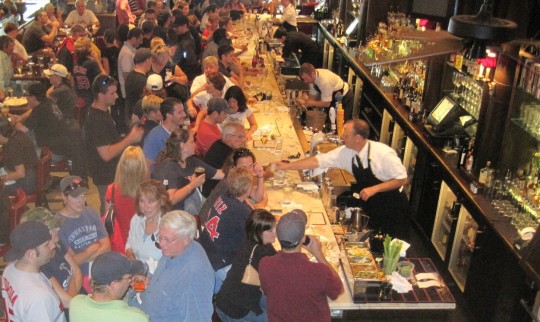
Bartending, and all service industry jobs, can be unnerving. Working a double can include 16 hours of set-up, service and clean-up that is physically and emotionally exhausting. Some stretches can be so busy that you barely have time to use the bathroom, and if there’s time to eat, it’s on the fly, standing up, often over a barrel… I remember coming home after marathon shifts, when I was wiped out beyond delirium, fighting to keep my eyes open, and struggling to muster the strength to shower before crashing. (Forgoing a shower after a sweaty shift is done at your own peril.) I remember passing out on my couch feeling battered beyond sore, as if I had bounced around in an industrial clothes dryer, twitching, jerking, and being startled awake because I was over-tired. Unless you’ve worked as a server in any capacity, and felt the tension, pressure and exhilaration that goes along with being in the fray, you will never have a full appreciation for the intensity of the experience.
Yes, you can empathize, but you will never know what it really feels like. You never know what you’re going to experience from one customer to the next. Some people are refreshingly wonderful, but far too often they are unnecessarily cruel, condescending, and selfish. I remember thinking to myself on several occasions that people would never speak to me the way that they did if they spent one full shift working with me, my co-workers, or any worker who deals with customers.
Working in the service industries is an extremely humbling, sometimes humiliating, and always an eye-opening experience. You develop a lot of empathy and appreciation for everyone who serves you the rest of your life after you’ve ‘been there,’ and it changes your entire approach to ‘customer service’ forever. In fact, I’ve had several conversations with servers contemplating a world full of people who worked a mandatory six-month stint in customer service. If everyone spent a little bit of time on the receiving end of the general public’s wrath, the world would be a lot more gracious, patient, and humble place.
Permalink | Posted in Family-Life Experiences | 9 Comments »