Boston & Beyond


Subscribe
Sign up for email updates on new blog posts.
Server Snapshots
Support Server Not Servant
To encourage more blog posts, and expedite the publication of the Server Not Servant book, please consider a (non-deductible) contribution. Thank you.
The Book
Search
Archives
The Best Defense Is a Good Offense
By: Patrick Maguire
Book Chapter: Confronting without Confrontation
Posted: 3/15/2010
Opening and operating a successful and profitable restaurant takes an extraordinary amount of hard work. If you’ve never been part of opening a new restaurant, it is a frenetic, frightening and fantastic experience. Everything is in a constant state of flux, and you’re always a phone call or moments away from disaster. (Licensing delays, kitchen meltdowns, delivery issues, construction catastrophes, and inspection issues, to name only a few.)
According to AA Gill, restaurant critic for The Sunday Times, 80% of independent restaurants fail within the first three years. In addition to the daunting odds stacked against them, restaurateurs also contend with an exploding number of amateur, know-it-all, online critics. Many of the entitled posters are anonymous, and naturally they are all experts at running a restaurant…
I’ve been an avid reader of restaurant reviews over the last several years. With sites like Citysearch, Chowhound, Yelp and OpenTable, anyone with internet access can broadcast an opinion to the world with very little effort. Some amateur reviewers do a tremendous job of considering all facets of operating a restaurant when posting their reviews. These folks are extremely thoughtful and fair, even when posting a very negative review. They’ll give a restaurant the benefit of the doubt, especially if the ‘problems’ they cite are not personally offensive, insulting or egregious. (Service issues at a new restaurant for example.) These reviewers have credibility because they care about restaurateur’s reputations and know that livelihoods are at stake.
Unfortunately, there’s a brigade of very irresponsible amateur reviewers who omit critical details when trashing a restaurant. Either they didn’t get their way, didn’t get something for free; or they instigated the problem. I’ve witnessed several exchanges between posters that eventually revealed “the rest of the story,” exonerating the restaurant, only to have the entire thread removed by the moderators of a site. I understand why most of the consumer sites side with the posters, but the credibility of the sites comes into question when moderators censor truths supporting restaurants and their personnel.
Some sites do offer restaurants an opportunity to share their side of the story. However, most have restrictions on how restaurants can respond and limitations on what they can respond to. The reality is that most busy restaurateurs don’t have time to respond to every inaccurate, negative comment made about their establishments. They’re too busy running their crowded restaurants!!
I’m going to discuss this topic at length in my book, but a couple of things happened over the last few weeks that I wanted to share.
I was enjoying dinner at the bar one evening when I heard a customer ask a host the dreaded question, Could I speak with a manager, please? The gentleman who asked for the manager met some resistance from his dining companion, but he remained firm and suggested she wait in the foyer if she didn’t want to hear the conversation. When the manager arrived, the customer looked him in the eye, introduced himself, calmly voiced his concern, and explained why he was leaving without eating dinner. After what looked like a productive conversation, the customer took the manager’s business card and shook his hand again before leaving. A class act.
Of course many customers race home to their keyboards and unmercifully rip restaurants to shreds, without the decency of giving the restaurant the benefit of the doubt, or an opportunity to right a wrong by speaking up when something happens. Great restaurants will do everything they can, within reason, to convert customers from guests to ambassadors. It was refreshing to see a customer step up and do the right thing instead of bombarding the Internet with “Never going back,” or, “Worst night ever,” next to the restaurant’s name. The customer who spoke up to the manager could end up become a loyal regular because he did the right thing.
Lastly, I’ve noticed a trend on facebook lately where more restaurants are posting about bad customer behavior immediately after it happens, before a customer can launch an attack. Here’s an example from one of the best restaurants in Boston that is extremely diligent about the execution of their food and their commitment to hospitality and great service;
Dear table X. We are sorry you needed to make a scene and storm out because we wouldn’t serve drinks to your underage child. No need to hurry back.
Very truly yours,
The Management.
This preemptive strike is brilliant, and inoculates anyone who might see a negative comment about the restaurant with “the rest of the story.” I recommend more restaurateurs follow suit and remember that the best defense is a good offense!
Interesting side note: According to Wikipedia; AA (Adrian Anthony) Gill was once ejected from one of Gordon Ramsay’s restaurants, along with his dining partner Joan Collins. Ramsay’s reason was that Gill had written a review of his restaurant that covered his personal life more than the food, including calling him a wonderful chef, but a “second-rate human being”.
Permalink | Posted in Confronting without Confrontation | 5 Comments »
You Missed a Spot
By: Patrick Maguire
Book Chapter: Personal Pet Peeves
Posted: 3/11/2010
On the facebook group I created to support my blog and book project, I’ve asked readers to submit photos of workers in action and their tools of the trade. I’ve also posted several of my own photos on the group page and here on the right-hand side of the blog. Some “expert” bloggers discourage the use of photos on blog pages because they think the photos are a distraction. I like showing real working people because I think it makes the blog posts more personal.
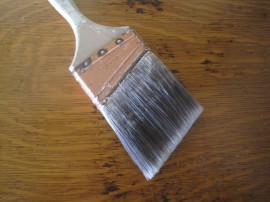 Earlier today, after thinking about a new profile picture for the facebook group, I decided to use one of my trusty, old, Purdy Paint Brushes for the photo. I used to operate a painting business and still own some of the brushes I used a very long time ago. As I was uploading the photo, I started thinking about all of the inane, nonsensical comments that people made while we were working. Most of the comments weren’t original or funny, and we heard them over and over again. They drove us crazy. So I sent a text to some of the guys who used to paint with me and asked them to remind me about the comments people made while we worked.
Here are a few of the responses, including some of my own pet peeves:
– When you’re done with that, can you come over to my house?
(Yes, as long as you’re prepared to pay us, preferably in cash.)
– What kind of paint do you use? (I would often say, Fred’s just to bust ’em.)
– Is it hot enough for you? (Someone would always make this comment on a hundred-degree day when we were scraping old paint directly over our heads with chips, dirt, and dust falling into our sweaty, open pores.) No, we actually wish it was 50 degrees hotter and more humid…
– You missed a spot. (No I didn’t. Get away from me.)
And then there were the people who would see us at breakfast, in a store, or at a gas station, with our work clothes covered with paint and caulking who would say, Looks like you have more paint on you than on the house, or, Did you get any on the wall? (Absolute idiots.)
Is it that hard to just shut up and walk on by when people are working? Too many people feel compelled to make stupid, clichéd small talk. Most workers loathe the gratuitous, asinine comments, and they’re not funny. (And the next time you see someone carrying flowers, please try to bite your tongue in lieu of, Are they for me?)
I know I’m sounding grouchy, but people in every industry have a certain amount of bullshit that they have to put up with. Some of it just goes with the territory and you have to suck it up and deal with it. However, some of it can be avoided, like the ridiculous comments from the peanut gallery.
I’d love to hear your stories about the stupid, redundant comments you’ve had to endure while on the job.
Permalink | Posted in Personal Pet Peeves | 36 Comments »
Entitlemania-How’s the Water?
By: Patrick Maguire
Book Chapter: Family-Life Experiences
Posted: 3/1/2010
I had a bit of an epiphany as I watched Tiger Woods stand at the podium and begin to atone for all of his stuff. I really don’t care about Tiger’s private life, but there was something about his statement and his circumstances that helped to clarify something for me. Despite his canned and robotic delivery, Tiger is one of the first people I’ve heard in a long time actually use the word entitled in his conciliatory statement. (And we’ve certainly had enough public apologies lately as a basis of comparison.)
For those of you who missed it, here are a few excerpts:
I knew my actions were wrong, but I convinced myself that normal rules didn’t apply (to me). I never thought about who I was hurting. I thought only about myself… I thought I could get away with whatever I wanted to. I felt that I had worked hard my entire life and deserved to enjoy all the temptations around me. I felt I was entitled. Thanks to money and fame, I didn’t have to go far to find them.
I was wrong. I was foolish. I don’t get to play by different rules…
My failures have made me look at myself in a way I never wanted to before…
Character and decency are what really count.
Even people who didn’t buy the scripted, staged, PR event admitted that he was brutally honest in his self-evaluation. Yes, it looked contrived when he repeatedly lifted his head, stared into the camera, and stated I am sorry, but no one can say that he didn’t address most of the issues head-on. I don’t care who coached him or wrote his speech, I give him credit for being direct and candid.
Tiger Woods is a very public figure who got caught. He was forced to take responsibility, publicly apologize, and to re-evaluate his entire life because he got caught. If he hadn’t been caught, he might have continued down the same path indefinitely.
When I listened to Tiger’s statement, I couldn’t help thinking about the 19% of customers who are impolite, disrespectful, or downright rude to customer service industry workers, and to people in general. Readers of this blog know that the 19% statistic comes from more than 200 former and current customer service industry workers I polled as part of the on-going research for my book. These customers, entitled, condescending and rude to service industry workers, have an inflated sense of self and think that common-sense rules regarding civility and mutual respect don’t apply to them.
There are so many reasons why narcissistic people think they are above the law. Like the late billionaire, “Queen of Mean”, Leona Helmsley, who claimed, Only the little people pay taxes, they suffer from inflated egos, and superiority complexes because of diplomas, pedigree, wealth, and looks, to name a few. A major part of the problem with these everyday entitled jerks is that many of them never have a cathartic, watershed moment that rocks their world and forces them to re-evaluate their actions and the way that they treat people. No one pushes back and confronts them or their behavior. They don’t “get caught,” so they continue to run roughshod over people. In fact, many of these people are enabled by their families, friends and colleagues, and their boorish behavior is encouraged because it’s not contested. Their entitlement and narcissism becomes self-fulfilling. When workers talk about rude, obnoxious, arrogant and abusive people, the entitled people are so impervious that they don’t even know that workers are talking about them.
One of my favorite stories was included in a commencement speech that the late author David Foster Wallace delivered in 2005 to the graduating class at Kenyon College:
There are these two young fish swimming along and they happen to meet an older fish swimming the other way, who nods at them and says “Morning, boys. How’s the water?” And the two young fish swim on for a bit, and then eventually one of them looks over at the other and goes “What the hell is water?”
This is a standard requirement of US commencement speeches, the deployment of didactic little parable-ish stories. The story [“thing”] turns out to be one of the better, less bullshitty conventions of the genre, but if you’re worried that I plan to present myself here as the wise, older fish explaining what water is to you younger fish, please don’t be. I am not the wise old fish. The point of the fish story is merely that the most obvious, important realities are often the ones that are hardest to see and talk about. Stated as an English sentence, of course, this is just a banal platitude, but the fact is that in the day to day trenches of adult existence, banal platitudes can have a life or death importance, or so I wish to suggest to you on this dry and lovely morning…
So let’s talk about the single most pervasive cliché in the commencement speech genre, which is that a liberal arts education is not so much about filling you up with knowledge as it is about “teaching you how to think”. If you’re like me as a student, you’ve never liked hearing this, and you tend to feel a bit insulted by the claim that you needed anybody to teach you how to think, since the fact that you even got admitted to a college this good seems like proof that you already know how to think. But I’m going to posit to you that the liberal arts cliché turns out not to be insulting at all, because the really significant education in thinking that we’re supposed to get in a place like this isn’t really about the capacity to think, but rather about the choice of what to think about. If your total freedom of choice regarding what to think about seems too obvious to waste time discussing, I’d ask you to think about fish and water, and to bracket for just a few minutes your skepticism about the value of the totally obvious…
The point here is that I think this is one part of what teaching me how to think is really supposed to mean. To be just a little less arrogant. To have just a little critical awareness about myself and my certainties. Because a huge percentage of the stuff that I tend to be automatically certain of is, it turns out, totally wrong and deluded. I have learned this the hard way, as I predict you graduates will, too.
Here is just one example of the total wrongness of something I tend to be automatically sure of: everything in my own immediate experience supports my deep belief that I am the absolute centre of the universe; the realest, most vivid and important person in existence. We rarely think about this sort of natural, basic self-centeredness because it’s so socially repulsive. But it’s pretty much the same for all of us. It is our default setting, hard-wired into our boards at birth. Think about it: there is no experience you have had that you are not the absolute centre of. The world as you experience it is there in front of YOU or behind YOU, to the left or right of YOU, on YOUR TV or YOUR monitor. And so on. Other people’s thoughts and feelings have to be communicated to you somehow, but your own are so immediate, urgent, real.
Please don’t worry that I’m getting ready to lecture you about compassion or other-directedness or all the so-called virtues. This is not a matter of virtue. It’s a matter of my choosing to do the work of somehow altering or getting free of my natural, hard-wired default setting which is to be deeply and literally self-centered and to see and interpret everything through this lens of self. People who can adjust their natural default setting this way are often described as being “well-adjusted”, which I suggest to you is not an accidental term.
I’ve had countless conversations with workers who describe some of their best customers as self-aware and cognizant of how their words and actions impact those around them. I think we could all use a little adjustment of our natural default settings. What do you think?
Permalink | Posted in Family-Life Experiences | 11 Comments »
Life Cycles-It Don’t Cost Nothin’ to be Nice
By: Patrick Maguire
Book Chapter: Human-to-Human Service
Posted: 2/16/2010
My brother Paul, the trailblazing oldest of ten, is a true road warrior. Since 1986, he has traveled 6,000+ miles in an RV from Alaska to Boston 8 times, usually with a couple of his beautiful Newfies in tow. During Paul’s trip at Thanksgiving, there were 3 of his Newfoundlands on board, including Boomer II, a new puppy named after our mom’s loyal dog of the same breed. I often tell Paul that his tales from the road would make a great reality show (Survivor RV?). He and his boys have survived some incredible endurance tests, including below zero, three dog nights, stuck in blizzards in some very remote areas. He’s often been at the mercy of strangers while stranded, waiting for parts to arrive from thousands of miles away to repair his rig. Knowing Paul, I think he likes the excitement, the edginess, and the risk involved in not knowing what’s around the corner. Part of the allure is the uncertainty of the road, and the challenge to be resourceful and resilient when tested.
As readers of this blog know, Paul has met some great people during his travels, and he often shares his stories with me. One of those people is Linda Akers, a Newfoundland breeder, who Paul became friends with while riding the LifeCycle at an Alaska fitness club. It’s only fitting that Linda is tied into this post because her husband, Charlie Akers, is a two-time Olympian, representing the USA Cross Country Ski Team at Squaw Valley in 1960, and the USA Biathlon Team at Innsbruck, Austria in 1964. Recently Linda shared a story about Bear Bryant, the legendary Alabama Football Coach with Paul, and Paul forwarded it to me. This story captures the core values that this blog and my book will represent, A Case for Human-to-Human Service and Civility.
Reprinted with permission from the author, Larry Burton:
At an Alabama Touchdown Club meeting in 1979, Coach Paul “Bear” Bryant told the following story:
I had just been named the new head coach at Alabama and was off in my old car down in South Alabama recruiting a prospect who was supposed to have been a pretty good player and I was havin’ trouble finding the place. Getting hungry I spied an old cinder block building with a small sign out front that simply said, “Restaurant.”
I pull up, go in and every head in the place turns to stare at me. Seems I’m the only white fella in the place. But the food smelled good so I skip a table and go up to a cement bar and sit. A big ole man in a tee shirt and cap comes over and says, “What do you need?” I told him I needed lunch and what did they have today? He says, “You probably won’t like it here, today we’re having chitlins, collared greens and black eyed peas with cornbread. I’ll bet you don’t even know what chitlins are, do you?” I looked him square in the eye and said, I’m from Arkansas, I’ve probably eaten a mile of them. Sounds like I’m in the right place. They all smiled as he left to serve me up a big plate. When he comes back he says, “You ain’t from around here then?”
I explain I’m the new football coach up in Tuscaloosa at the University and I’m here to find whatever that boy’s name was and he says, yeah I’ve heard of him, he’s supposed to be pretty good. And he gives me directions to the school so I can meet him and his coach. As I’m paying up to leave, I remember my manners and leave a tip, not too big to be flashy, but a good one and he told me lunch was on him, but I told him for a lunch that good, I felt I should pay. The big man asked me if I had a photograph or something he could hang up to show I’d been there. I was so new that I didn’t have any yet. It really wasn’t that big a thing back then to be asked for, but I took a napkin and wrote his name and address on it and told him I’d get him one and shook his hand and left.
I met the kid I was lookin’ for later that afternoon and I don’t remember his name, but do remember I didn’t think much of him when I met him. I had wasted a day, or so I thought. When I got back to Tuscaloosa late that night, I took that napkin from my shirt pocket and put it under my keys so I wouldn’t forget it. Back then I was excited that anybody would want a picture of me. The next day we found a picture and I wrote on it, “Thanks for the best lunch I’ve ever had.”
Now let’s go a whole buncha years down the road. Now we have black players at Alabama and I’m back down in that part of the country scouting an offensive lineman we sure needed. Y’all remember, (and I forget the name, but it’s not important to the story), well anyway, he’s got two friends going to Auburn and he tells me he’s got his heart set on Auburn too, so I leave empty handed and go on to see some others while I’m down there.
Two days later, I’m in my office in Tuscaloosa and the phone rings and it’s this kid who just turned me down, and he says, “Coach, do you still want me at Alabama?” And I said, Yes, I sure do. And he says OK, he’ll come. And I say, Well son, what changed your mind? And he said, “When my grandpa found out that I had a chance to play for you and said no, he pitched a fit and told me I wasn’t going nowhere but Alabama, and wasn’t playing for nobody but you. He thinks a lot of you and has ever since y’all met.” Well, I didn’t know his granddad from Adam’s house cat so I asked him who his granddaddy was and he said, “You probably don’t remember him, but you ate in his restaurant your first year at Alabama and you sent him a picture that he’s had hung in that place ever since. That picture’s his pride and joy and he still tells everybody about the day that Bear Bryant came in and had chitlins with him. My grandpa said that when you left there, he never expected you to remember him or to send him that picture, but you kept your word to him and to Grandpa, that’s everything. He said you could teach me more than football and I had to play for a man like you, so I guess I’m going to.”
I was floored. But I learned that the lessons my mama taught me were always right. It don’t cost nothin’ to be nice. It don’t cost nothin’ to do the right thing most of the time, and it costs a lot to lose your good name by breakin’ your word to someone.
When I went back to sign that boy, I looked up his Grandpa and he’s still running that place, but it looks a lot better now; and he didn’t have chitlins that day, but he had some ribs that woulda made Dreamland proud and I made sure I posed for a lot of pictures; and don’t think I didn’t leave some new ones for him, too, along with a signed football.
I made it clear to all my assistants to keep this story and these lessons in mind when they’re out on the road. If you remember anything else from me, remember this. It really doesn’t cost anything to be nice, and the rewards can be unimaginable.
I called the author of this tale, Larry Burton, seeking permission to share his story, and had a nice chat with him. Larry is an Alabama Alum and still writes for The Bleacher Report and Touchdown Alabama Magazine. He can be reached by email at finder@digitalexp.com.
At the conclusion of our conversation, I invited Larry to break bread with me the next time he visits Boston. Larry reciprocated by inviting me to raise a glass or 2 at his Tiki Bar in his backyard in Florida. My kinda guy… Sounds pretty good as it’s snowing here in Boston.
Many thanks to my brother Paul and all other readers who have been sharing the mission of this blog in their travels. I am grateful.
Permalink | Posted in Human-to-Human Service | 13 Comments »
Water Experiment
By: Patrick Maguire
Book Chapter: Observe / Analyze
Posted: 2/5/2010
I was reading the paper and having breakfast at the counter at one of my favorite greasy spoons this week, when a guy came in and sat a few stools away. I’m always doing research for my book, so naturally I listened in. The waitress approached him with her typical, Coffee, Hon? He replied, Yes, half regular and half decafe. Don’t refill it when I’m half done; you’ll mess up the balance of the cream and sugar.
As is often the case, I started to wonder if people realize how many personal, idiosyncratic preferences we have when it comes to eating and drinking. Of course servers know this, but I thought it would be fun to do an experiment to illustrate the point that there are hundreds of variables that go into every restaurant dining experience.
I’ve read thousands of amateur and professional reviews of restaurants over the years. Ok, it’s an obsession. The more I read, the more I know that you “can’t please all of the people all of the time,” especially with something as subjective as dining out. Everyone has their own idea of exactly how things should be done. The next time you’re dining out with a group, ask everyone what they would do differently about the music, lighting, temperature, noise level, food, drinks,service and ambiance of the restaurant. Or just ask about something as simple as the bread. Do they like the bread? Is it warm enough? Do they like sea salt on their butter? Olive oil instead of butter? Rolls instead of bread? Bread before ordering food or with appetizers? If they owned the restaurant, what kind of bread would they serve?
Initially I thought about including personal preferences regarding a few items in this experiment (coffee, bread + water), but I decided to keep it as simple as possible.
What is your exact personal preference in terms of drinking water in restaurants?
Here are a few variables to think about:
- Tap, filtered, bottled, flat, sparkling…
- I only drink _______ brand.
- On-premise, well water if you have it.
- Fresh, running mountain stream only.
- Flavored
- Sippy cover for kids
- Ice/Crushed ice/No ice
- Freezing cold, room temp
- Imported/domestic
- Big glass, wine glass, short glass, tall glass…
- I don’t drink water and I get upset when the server brings it automatically because the world is running out of water, dammit!!
- Lemon? Lime? 3 lemons and 1 lime, but don’t squeeze them…
- Other fruit?
- I want my water waiting at my table and filled vigilantly until I get up to leave. I have a stopwatch and I will blast you on CitySearch, Chowhound, Yelp, and every other amateur review site if my water isn’t refilled within 1.25 minutes of being empty.
- I like when the server leaves a pitcher so we can just fill our glasses at our own pace.
- Straw/No straw
My preference is room-temperature tap water, served in a large glass with no ice, no fruit, no straw. If I’m away from the table when the server takes the order and pours water for the table, I’ll drink whatever is put in front of me. I prefer that my water is replenished throughout the meal. I never bring a stopwatch to a restaurant, and I think nothing of getting up and mentioning refills for our table if necessary.
After we see how easy it is to satisfy our water selections, we’ll talk about menus, drinks and bread. That’s when the real fun begins…
So, in a perfect world, what kind of water do you drink in a restaurant, and how is it served?
Let’s see if we can get 40 responses. Please take a moment to add your comment below. Thank you.
Permalink | Posted in Observe / Analyze | 49 Comments »